beginner9 min read
What You Can Trade
#etf#index#derivatives#instruments
What You Can Trade
In one line: The market sells many different products — stocks and ETFs are the simple ones to start with, and derivatives are the advanced ones to leave for later.
🎯 What you'll learn
- What a stock, an ETF, and an index really are.
- Why an ETF is like buying a whole fruit basket in one go.
- What futures and options are, in simple words.
- Why derivatives are risky and best left for later.
📘 Key concepts
Stocks (also called equity or shares)
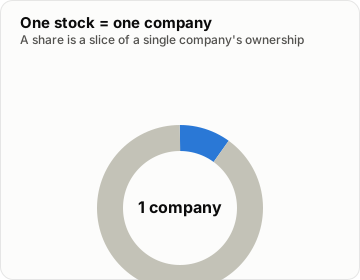
A stock is a tiny piece of ownership in one company.
- Think of a company as a big pizza. A share is one slice.
- If you own shares, you own a small part of that company.
- Buy shares of one company (say a car maker), and your money rises or falls with that one company.
- Equity just means "ownership". Stock, share, and equity all point to the same thing.
- Simple to understand: one company, one price.
ETF (Exchange Traded Fund)
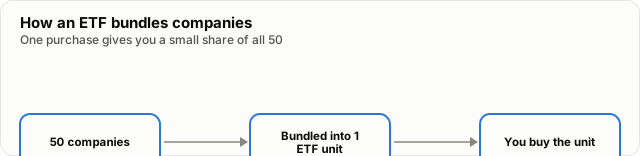
An ETF is a ready-made basket of many stocks bundled into one unit you can buy.
- Exchange = the marketplace where things are bought and sold (like NSE or BSE in India).
- Instead of buying 50 companies one by one, you buy one ETF unit and get a small share of all 50.
- Example: a Nifty 50 ETF holds all 50 companies of the Nifty 50 index.
- This gives instant diversification (spreading money across many things, so one bad company hurts less).
- It is like buying a mixed fruit basket instead of picking each fruit alone.
- Usually low cost and easy for beginners.
Index (Nifty 50, Sensex)
An index is a scoreboard. It tracks a group of top companies to show how the market is doing overall.
- Like a cricket scoreboard that adds up runs to show the team's total.
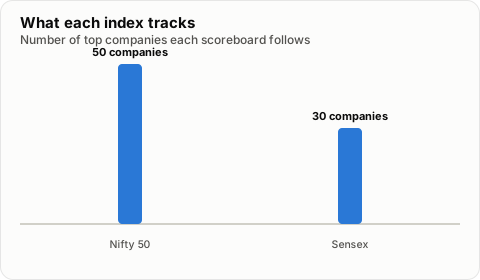
- Nifty 50 tracks 50 big companies. Sensex tracks 30 big companies.
- When you hear "the market went up today", people usually mean the index went up.
- Important: you cannot buy an index directly. It is just a number.
- To follow an index, you buy an ETF or a derivative that tracks it.
Derivatives (futures and options) — advanced
A derivative is a product whose price comes from something else (like a stock or an index). Two common types:
- Futures = an agreement to buy or sell something at a set price on a future date. You must complete the deal on that date.
- Options = the right, but not the duty, to buy or sell at a set price. You can walk away if it does not suit you.
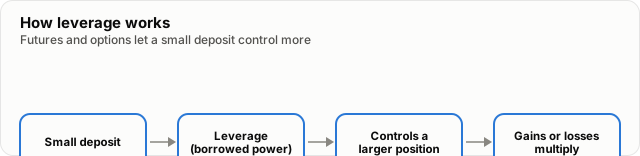
- Both use leverage (borrowed buying power). You control a big amount with a small deposit.
- Leverage can multiply your gains — but it multiplies your losses the same way.
- These are advanced tools. Beginners should learn them much later, after lots of practice.
🔍 Example
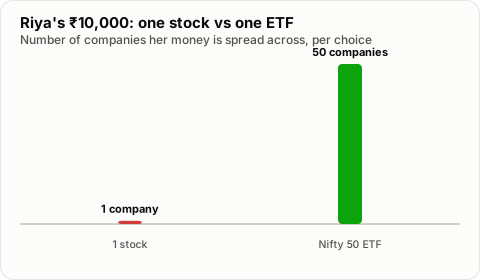
Riya has ₹10,000 to invest. She sees three choices:
- One stock: she buys shares of a single company. If that company does well, she gains. If it stumbles, she alone feels it.
- One ETF: she buys a Nifty 50 ETF. Her ₹10,000 now sits across 50 companies. One weak company barely moves her total.
For a beginner, the ETF gives a smoother, calmer ride while she learns.
⚠️ Common mistakes
- Trying futures and options first because they promise "fast money" — this is how beginners lose money quickly.
- Thinking you can "buy the Nifty" directly. You cannot; you buy an ETF or derivative that tracks it.
- Putting all money into one single stock and calling it "investing".
- Ignoring leverage — small moves can wipe out your deposit fast.
- Confusing an ETF with a single stock; an ETF is a basket, not one company.
✅ Key takeaways
- A stock is ownership in one company.
- An ETF is a basket of many stocks in one unit — instant diversification, low cost.
- An index is a scoreboard; you track it through an ETF or derivative.
- Derivatives (futures, options) use leverage and are advanced.
- Beginners should start with stocks and ETFs, and learn derivatives much later.
📝 Quick check
- Q: You want to own a small part of 50 top companies with one purchase. What do you buy? A: An ETF, such as a Nifty 50 ETF.
- Q: Can you buy the Nifty 50 index directly? A: No. It is just a scoreboard. You buy an ETF or derivative that tracks it.
- Q: Why are derivatives risky for beginners? A: They use leverage (borrowed power), which multiplies both gains and losses.
📖 New words
- Stock / Share / Equity — a small piece of ownership in one company.
- ETF (Exchange Traded Fund) — a ready-made basket of many stocks bought as one unit.
- Exchange — the marketplace where shares are bought and sold (e.g. NSE, BSE).
- Diversification — spreading money across many things so one loss hurts less.
- Index — a scoreboard number that tracks a group of top companies.
- Derivative — a product whose price comes from another thing, like a stock or index.
- Futures — an agreement to buy or sell at a set price on a future date.
- Options — the right, not the duty, to buy or sell at a set price.
- Leverage — borrowed buying power that multiplies both gains and losses.
Educational content only — not financial advice. Trading involves the risk of losing money.