beginner8 min read
Market Hours & the Order Book
#liquidity#bid-ask#sessions
Market Hours & the Order Book
In one line: The market is open only at set hours, and inside it a live list of buy and sell prices, called the order book, decides the price you get.
🎯 What you'll learn
- When the stock market is open and closed.
- What an order book is and how to read it.
- The meaning of bid, ask, and spread.
- What liquidity and volume are, and why they matter to you.
📘 Key concepts
Market hours (the open and close)
The market is like a shop. It only trades when the shutter is up.
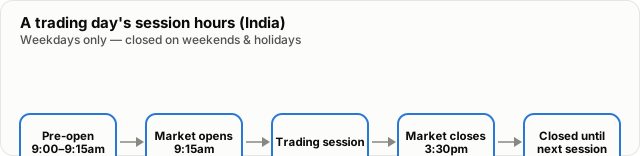
- In India, the main session runs about 9:15 am to 3:30 pm on weekdays (Monday to Friday).
- It is closed on weekends and on public holidays.
- There is a short pre-open session (about 9:00 am to 9:15 am) [a warm-up window where orders are collected to set a fair opening price].
- Other countries have different hours. A US market or a UK market opens at its own local time.
- Why this matters: if you place an order when the market is shut, it just waits. Nothing trades until the shutter goes up again.
The order book (the live price list)
The order book is the heart of the market.
- Order book = a live list of every pending order [an order that is waiting, not yet completed].
- The left side lists buy orders. The right side lists sell orders.
- Each line shows a price and a quantity [how many shares are wanted or offered at that price].
- It updates every second as people add, change, or cancel orders.
- Think of it as a scoreboard showing what buyers and sellers want right now.
Bid, ask, and spread
These three words describe the top of the order book.
- Bid = the highest price a buyer is willing to pay right now.
- Ask (also called the offer) = the lowest price a seller will accept right now.
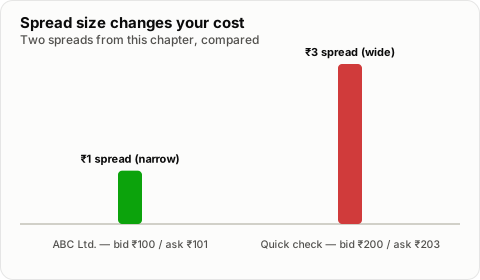
- Spread = the gap between the bid and the ask.
- A narrow spread (small gap) means the two sides nearly agree. This is a smooth, easy market.
- A wide spread (big gap) means they disagree. Trading here can cost you more.
Liquidity and volume
These two words tell you how "busy" a stock is.
- Volume = how many shares changed hands (traded) in a period, like one day.
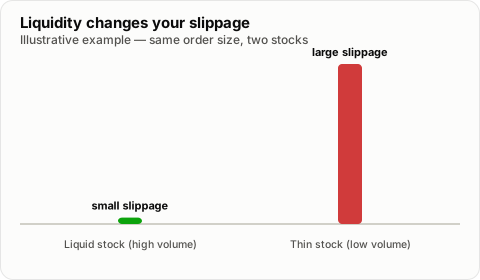
- Liquidity = how easily you can buy or sell without pushing the price around.
- High volume usually means high liquidity.
- In a liquid stock you enter and exit quickly, near the price you see.
- Slippage [the difference between the price you expected and the price you actually got] is small in liquid stocks and large in thin ones.
🔍 Example
Imagine the order book for one share of "ABC Ltd."
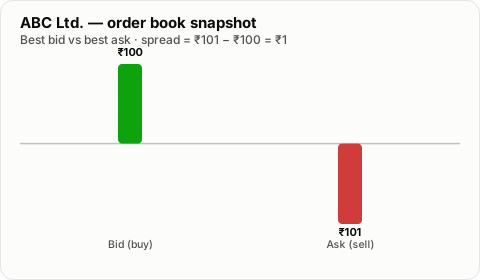
- The bid is ₹100 (the best price a buyer offers).
- The ask is ₹101 (the cheapest a seller offers).
- The spread is ₹101 − ₹100 = ₹1. That is a narrow spread, so this is a fairly liquid stock.
- If you want to buy right now, you pay ₹101 (the ask).
- If you want to sell right now, you get ₹100 (the bid).
- A trade happens the moment a buyer and a seller agree on the same price.
Picture a busy fish market. Buyers shout the price they will pay, sellers shout the price they want. When two shouts match, the fish is sold. The order book is that same shouting, written down and updated live.
⚠️ Common mistakes
- Thinking the "last price" you see is the price you will get. You buy at the ask and sell at the bid.
- Ignoring the spread. A wide spread quietly eats into your money on both entry and exit.
- Trading a low-volume stock with a big order, then being shocked when your own order moves the price.
- Placing orders after the market closes and expecting them to fill instantly.
- Assuming every market opens at 9:15 am. Hours change from country to country.
✅ Key takeaways
- The market trades only during set hours; in India, about 9:15 am to 3:30 pm on weekdays.
- The order book is a live list of all waiting buy and sell orders.
- Bid = best buy price; Ask = best sell price; Spread = the gap between them.
- A narrow spread and high volume mean a liquid, easy-to-trade stock.
- Liquid stocks let you enter and exit with less slippage.
📝 Quick check
- Q: You want to buy a share right now. Do you pay the bid or the ask? A: The ask (the lowest price a seller will accept).
- Q: The bid is ₹200 and the ask is ₹203. What is the spread, and is it narrow or wide? A: The spread is ₹3. That is fairly wide, so this stock is less liquid.
- Q: Why is a high-volume stock usually easier to trade? A: Because it is more liquid, so you can buy or sell quickly with less slippage.
📖 New words
- Order book — a live list of all pending buy and sell orders for a stock.
- Pending order — an order that is waiting and not yet completed.
- Pre-open session — a short warm-up window before the main session that sets a fair opening price.
- Bid — the highest price a buyer is willing to pay right now.
- Ask (offer) — the lowest price a seller will accept right now.
- Spread — the gap between the bid and the ask.
- Volume — how many shares traded in a given period.
- Liquidity — how easily you can buy or sell without moving the price much.
- Slippage — the difference between the price you expected and the price you actually got.
Educational content only — not financial advice. Trading involves the risk of losing money.